THREAD TENSION
Proper thread tension on the embroidery machine is critical for beautiful, smooth and even embroidery.
The stitch is created by interlacing the top thread and the bobbin thread. This so-called two-thread system is responsible fpr an even embroidery pattern, camparable to the seam pattern in sewing.
It is therefore imporant to check and adjust not only the top thread tension, but also the bobbin thread tension.
The top thread tension is directly influenced by the selected thread and its weight, e.g. 40 count, 60 count, 30 count, 12 count, etc. Other influences on the top thread tension are the motif (embroidery program), the base fabric and the embroidery machine used.
The bobbin thread can be chosen as thin as possible: the thinner the bobbin thread, the easier the stitches will lay, because this gives more space for the top thread. In addition, more bobbin thread fits on the bobbin and thus ensures a longer running time of the machine.
✔ Rule No.1: Check the top and bobbin thread tension before you start embroidering!
The top thread tension is the actual thread, which we adjust according to the top thread thickness. If we tighten the top thread tension, we see less bobbin thread, if we loosen the top thread tension, we see more bobbin thread on the reverse side.
The top thread tension is correct when the embroidery pattern is even, no loops are visible on the top, the fabric around the embroidery does not pucker and lines are exact and straight. If this is not the case, look at the reverse side and adjust the top thread tension until approximately the ratio 1/3 to 2/3 is achieved.
However, this rule of thumb should only be used as a guide for 40 or 60 weight threads. Thicker threads, such as 30 or 12 weight threads, are considerably more bulky and do not allow the bobbin thread to be seen to any great extent.
✔ Rule No.2: The ratio of top thread to bobbin thread, should be 1/3 to 2/3 on the wrong side of the fabric (back side), i.e. 1/3 bobbin thread, 2/3 top thread.
The bobbin thread tension is only set once, and can be checked from time to time during the course of the day, but otherwise does not need to be adjusted.
Wear due to use in the machine and dropping of the capsule and/or bobbin can negatively affect the even unwinding of the bobbin thread.
✔ RRule No.3: Check the bobbin case and the bobbin for sharp edges or unevenness at regular intervals.
Tip:
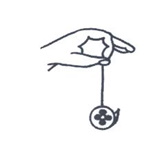
The bobbin thread tension is correct when the bobbin case with the bobbin inserted just holds the weight of the bobbin case when the thread is held between the fingers (as illustrated below).
Gently jerk the thread, the bobbin case should slightly move downwards. If it doesn't move at all then most likely the tension is too tight.
If the bobbin case moves downward by just holding the thread, then the tension is too loose.
We had a test pattern, in the shape of a square, digitized to help you set the correct top thread and bobbin thread tension
The motif contains two decisive criteria:
- - Embroidery is done in longitudinal and transverse direction (x- and y-axis)
- - Embroidery of the two most important basic stitches: backstitch and satin stitch
The square is saved at www.gunold.de for the most important thread counts (40, 60, 30, 12) in different densities.
You will find it under the respective "Top Thread" in the download section under: Test Pattern
It is best to work with contrasting colors when testing.
Now you can check that all the directions the machine embroiders are set at the correct thread tension: pay attention to the 1/3 to 2/3 rule for satin stitch, and a flat embroidery pattern for backstitch to avoid any loops.
We wish you lots of fun and success!
THREAD BREAKAGE? UNNECESSARY!
Ideally, it won´t even come to it!
For the embroiderer a thread break is always annoying. If the thread breaks, the embroidery machine will stop and has to be rethreaded. This is unnerving, timeconsuming and interrupts the work that is currently being done. However, the lost time is by far not the only nuisance.
The drop in productivity caused by non-operation periods is increasingly expensive, the more embroidery heads the machine has. A thread break on one head causes a complete standstill of all embroidery heads. But what is even worse is the loss of quality of the embroidered goods because of thread breaks
These are the reasons: If a thread breaks, the last embroidered stitch just before the breakage has occurred cannot be fastened properly. After rethreading, the same is true for the first stitch after the machine resumes the embroidery process. This may cause the stitches to unravel later on and may result in ugly gaps in the embroidery design. Complaints are then inevitable or even worse, the customer won’t order again.
Even if done correctly, by stepping back a few stitches and overlapping the stitches where the thread breakage occurred, this will be visible in the embroidery design. When embroidering a satin stitch, the area, where the stitches overlap, “only” appears to be slightly thicker but when embroidering an area with fill stitches, the overlapping stitches are inevitably visible.
Quality Threads - The better Choice!
Needless to say that thread breakage may occur with any embroidery thread. But a lot of times it is caused by different reasons such as thread tension, the embroidery needle, incorrect framing of the fabric or, last but not least, by the embroidery program that has to be digitized adequately to the specific design, the fabric and the embroidery thread.
The truth of the matter is that high quality threads or rather premium embroidery threads without any doubt decrease the chance that a thread break will occur. High-quality embroidery threads such as SULKY or POLY made by GUNOLD are made of high quality raw materials.
Lubricants, applied to the embroidery thread as a coating ensure smooth running of the thread throughout the whole thread pass. Even if you cannot see, feel or smell the lubricants, taking into consideration the different raw materials and colours, the right amount of lubricants is individually applied to each thread. It goes without saying that premium threads stand for consistently high breaking strength and colour fastness, as well as for a low tolerance in colour deviation and the identical thread size in all colours and dye batches of a particular thread type. Last but not least premium embroidery threads are typically available for immediate shipment in all colours of the colour card.
Embroiderers who count on cheap threads, produced predominantly in the Far East, give up this security of high quality embroidery threads, resulting in changing breaking strengths and thread colours as well as fluctuations of thread sizes within the same thread quality. Even the use of lubricants is not guaranteed, resulting in thread breaks and an uneven appearance of the embroidery design. But first and foremost, laboratory tests clearly show that producers of cheap embroidery threads use inferior raw materials to save money.
Cleverly calculated: A cheap thread almost always leads to production loss and loss of quality
When buying quality embroidery threads, you can be assured
- that the thread quality stays the same for each order
- that there are almost no colour deviations
- that only premium raw materials are being used
- that technically mature lubrication techniques lead to the best possible runnability
- that all colours are available for immediate shipment in all colours of the colour card
When buying cheap embroidery threads you should know
- that not all the shipments will be in the same quality
- that there can be huge colour deviations from one order to the next
- that colours ordered according to the colour cards won’t be the same as shown
- that often inferior raw materials are being used
- that insufficient or non-existent lubrication of embroidery threads lead to inadequate runnability
- that there may be backlogs, especially for colours that are not in high demand
Embroidered with SULKY by GUNOLD
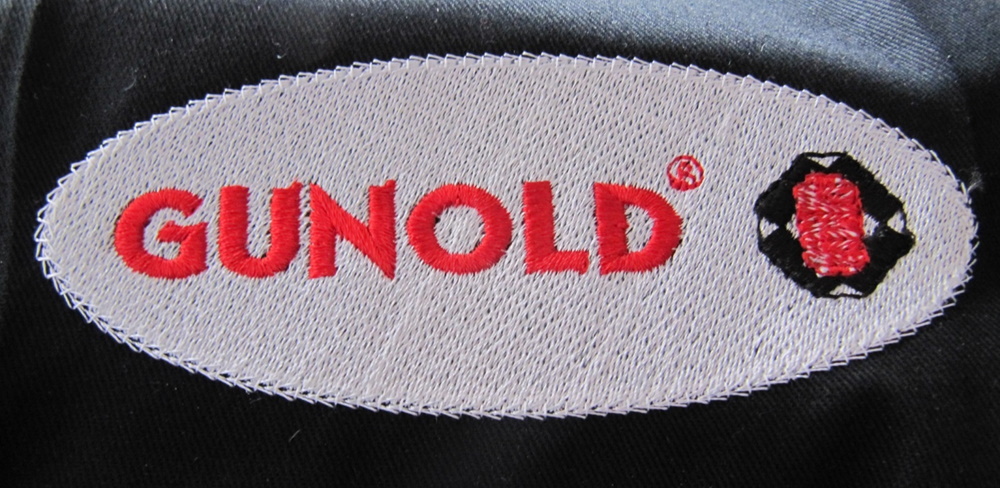
Pictures 1 – Overlapping stitches are clearly visible